Home » Knowledge Hub »
With big leaps come big footprints: AI for the climate conscious

AI delivers real productivity gains, but that value comes at an environmental cost that’s often hidden behind the screen. Data centres consume vast amounts of energy and water and every prompt carries a carbon footprint most businesses never see.
Being climate-conscious about AI doesn’t mean avoiding it. Use it deliberately, matching the tool to the task and asking whether the value created is proportionate to the cost, so AI supports your sustainability goals rather than working against them.
Since 2023, it has been hard to get through a conversation without someone mentioning AI. Adoption has varied across sector and organisation size but the truth remains that artificial intelligence tools are becoming commonplace in and out of the workplace.
It’s no surprise why. Since the launch of OpenAI’s ChatGPT in November 2022, artificial intelligence has been accessible to billions of people. This superpower makes the impossible possible. Developers working across platforms like WordPress, Craft CMS and beyond can create proofs of concept in a fraction of the time, operations professionals can make significant time and cost savings and folks who have never before touched photoshop can create miraculous designs almost instantly.
The professional world has been racing to make time savings, find innovative ways to leverage AI and redesign workflows to avoid being left behind. However, there is a very real cost: AI is terrible for the environment. How do environmentally conscious companies reconcile with the power consumption of artificial intelligence? This is something many businesses are now considering as part of wider digital sustainability strategies.
The value is real
Let’s not pretend otherwise, AI is extraordinary. A landmark 2023 study by researchers from Harvard Business School, MIT and Wharton, conducted with 758 BCG consultants, found that AI users completed tasks 25% faster than a control group, with a 40% improvement in quality.
The most obvious gain is productivity, speeding up a cumbersome process or eliminating it all together. The common perception of AI adoption means outsourcing your boring admin tasks to a robot to free up your time to focus on the elements of your job that AI cannot do.
However, many industries are finding opportunities to enhance their output in other ways. Using AI to enable you to deliver things that would otherwise be outside your skillset. Non-coders are building apps, graphic designers are animating and marketers are producing written content that previously would have been outsourced to a professional copywriter.
The accessible nature of generative AI, and its impressive results means there is no surprise how quickly its adoption has spread. We’re already seeing this shift play out in areas like web development, where AI is helping automate tasks, improve efficiency and enhance user experience. In fact, in less than three years, more than 1.2 billion people have used AI in some form—a rate of adoption faster than the internet, the personal computer, or even the smartphone, according to Microsoft’s 2025 AI Diffusion Report. We are in the midst of an industrial revolution, the fastest in history. Unlike the industrial revolutions of the past, we aren’t seeing factories churning out billowing columns of smoke; it feels clean and efficient and virtual. The reality is anything but clean.
The environmental cost of AI is hiding in plain sight
Behind every ChatGPT prompt, every Fireflies meeting transcript and every Copilot-assisted email, is a rapidly expanding physical infrastructure of data centres: enormous warehouses packed with servers running 24 hours a day. With fossil fuels still accounting for over 60% of global electricity generation, the power needs of generative AI are largely being met with non-renewable energy.
Organisations that had previously committed to reducing their greenhouse gas emissions are citing data centre development as the reason for their increase. In 2019 Amazon set a goal to reach net-zero emissions by 2040. In 2024, Amazon recorded its first emissions increase since 2021. Similarly, Google’s greenhouse gas emissions increased by 48% since 2019 for the same reason.
These datacentres don’t just need electricity, they need enormous quantities of water to prevent their servers from overheating. Large data centres can consume up to 5 million gallons of water per day, according to the Environmental and Energy Study Institute (EESI). Yet a study published in Nature’s npj Clean Water found that fewer than one third of data centre operators actually measure their water consumption, meaning this is likely being underreported. On a per-prompt level, researchers at the University of California, Riverside estimate that each 100-word AI query uses roughly 500ml of water, approximately one standard bottle, to cool the servers processing your request.
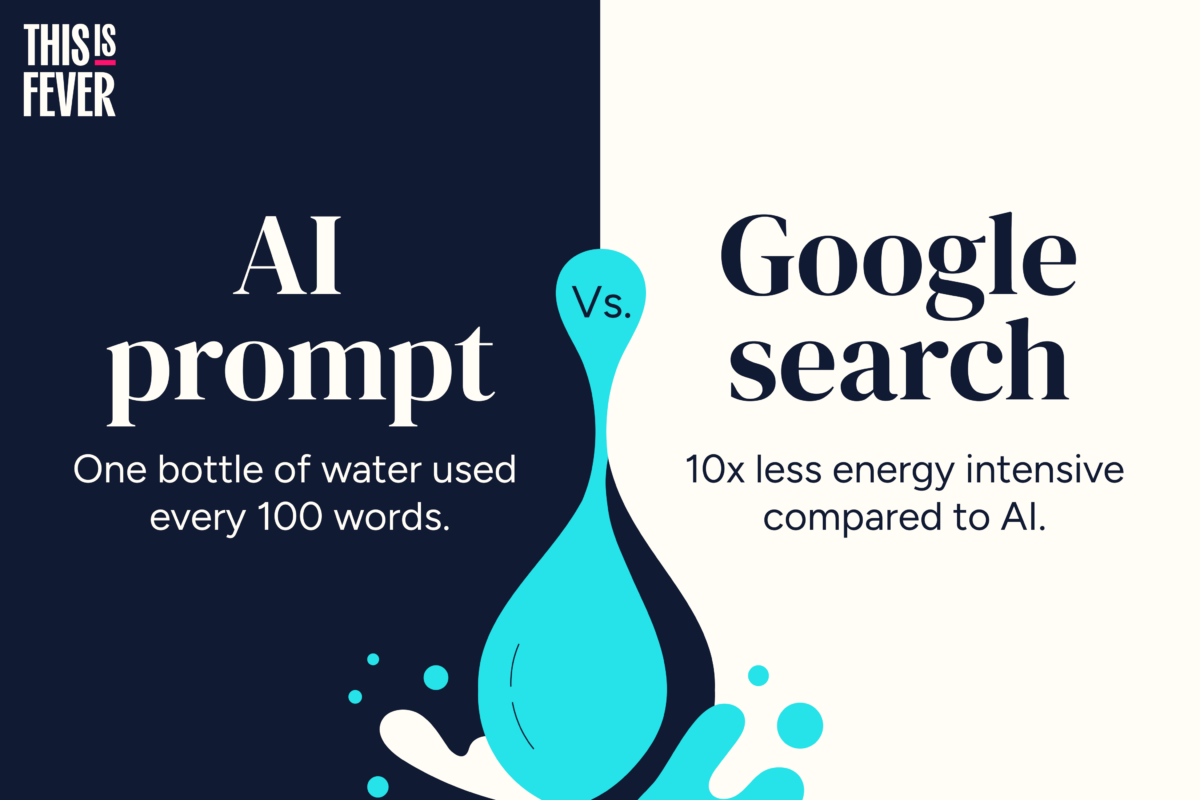
Let’s break this down. Each 100-word AI prompt is estimated to use one bottle of water and 0.03g – 2g of CO2e. This is roughly ten times more energy intensive than a traditional Google search.
The difficult questions.
So the benefits are real, the problem is real and the pressure to adopt AI or risk falling behind your competitors is also real. Where do we go from here?
How can I possibly use AI when I know what damage it’s doing?
It’s a great question and one that many people are struggling with. It’s easy to feel caught between a rock and a hard place, weighing up the productivity savings against the carbon costs. With the advantages AI can unlock, abstaining from AI entirely isn’t likely to be on the table for most businesses.
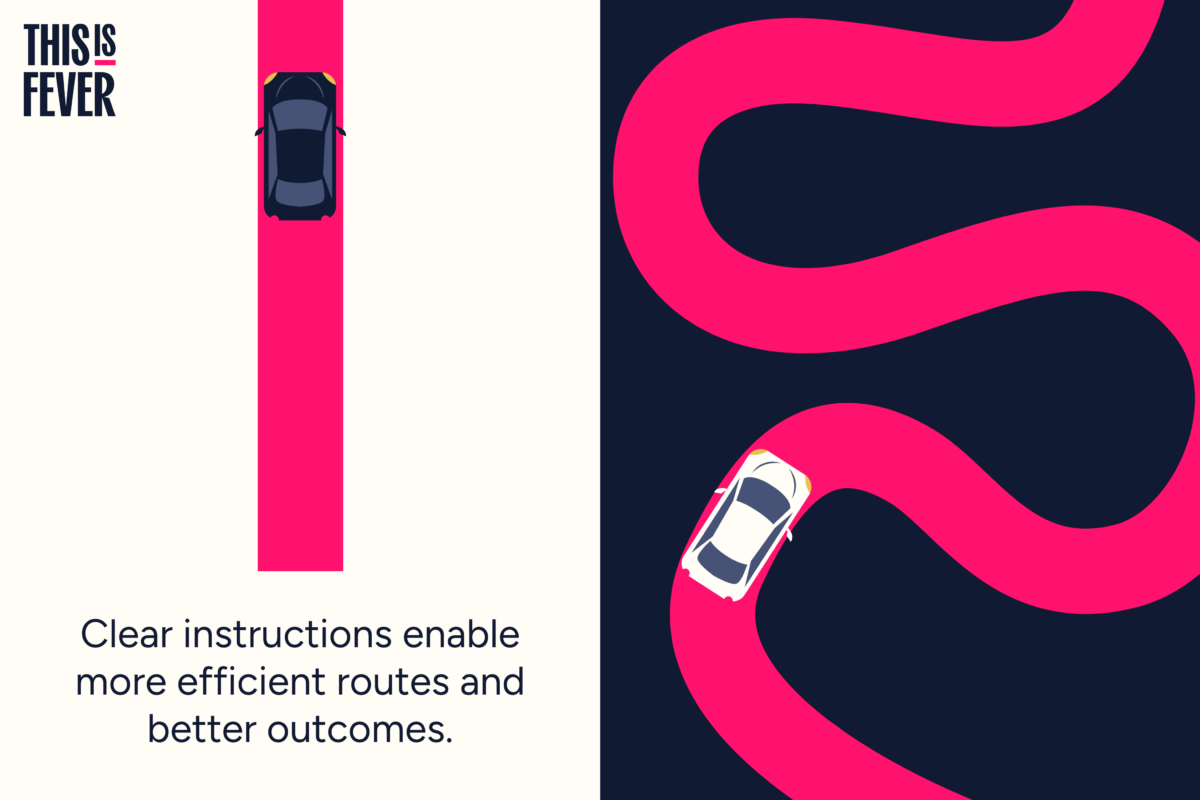
Instead, businesses should consider how they are using AI. The environmental impact of AI isn’t fixed, a text prompt to a lightweight language model uses significantly less energy than generating an image or video would. A tight, well-scoped query compared to an open-ended question can bring you to your desired result faster and with a much smaller carbon footprint (imagine the fuel consumed by your car on the most direct route, compared to the scenic route). Work out what will get you from A to B for the most efficient experience.
We have a net zero target, do I have to choose between carbon-zero and savings with AI?
There is plenty to keep operations directors up at night these days, but this one is a real conundrum. If you’re deploying AI at scale without factoring its environmental impact into your Scope 3 emissions, you’re undermining your net zero commitments.
However, the whole reason that this is an issue is because AI is a fiercely powerful tool in a business’ arsenal. The very tool creating this tension can also ease it. AI can be used to optimise energy consumption, support ESG reporting and model the impact of carbon decisions. Schneider Electric, the French energy management and industrial automation company, is one of the most cited examples of AI being used not just alongside a net zero strategy, but as a core instrument of it.
Schneider is a huge organisation, but the principle applies for smaller companies too. One of AI’s superpowers to small businesses is to make the invisible visible. Turning carbon from an abstract annual reporting exercise into something that can be acted on in real time. According to SAP, only 14% of companies are currently using AI to reduce carbon emissions and so businesses that start now aren’t just ahead of the curve, they’re building a muscle that will make them more resilient and more appealing to regulators, investors and customers alike.
Should responsible businesses use AI at all?
This is a big question. On the one hand, AI has a very real impact on the globe and at times directly contributes to climate change. On the other hand, it can be leveraged as an optimisation layer to reduce carbon emissions. The answer is simple: yes, with conditions.
A responsible business using AI isn’t one that uses it without question. It’s one that asks two simple questions to check if their deployment is justified:
- What does this deployment cost in environmental terms?
- Is this cost proportionate to the value created?
For example, jumping on a social media trend to create an AI-generated action figure will produce very different answers to A mid-sized business using AI to review supplier contracts for ESG compliance clauses.
These sense-check questions will help responsible businesses identify where AI usage makes sense, and where it is disposable.
The pipe and the coffee stirrer
The parallel between AI and plastic has been drawn before. AI slop is clogging up the internet like microplastics clogging up a waterway. It’s a fair critique. At This is Fever, we think the analogy can be a useful checkpoint when justifying the use of AI.

Plastic. Few materials have attracted more justifiable criticism over the past ten years. We know what it does to the ocean, how long it takes to degrade in landfill and in recent years we’ve learnt that we’ve probably eaten a lot more of it than we should have.
And yet, plastic is still the right material for a water pipe. It doesn’t rust, it’s durable, it lasts decades underground without degrading. The problem was never the plastic itself. The problem was how we applied it, as if every use of this supermaterial was equally valuable. This led us to the same material being used for a pipe intended to stay in the ground for fifty years and a coffee stirrer used for thirty seconds.
Responsible businesses can give Generative AI the same distinction. When you ask AI to generate a personalised action figure for a social media trend, you’re triggering an energy-intensive image generation process for something that will be looked at once before being lost in the oblivion of your LinkedIn feed. At the other end of the spectrum, a business using AI to automate its carbon footprint reporting, comparing supplier data and forming a strategy is leveraging the same tool for something that will live on and its value will be proportional to the cost of its value.
Before beginning your next AI prompt, ask yourself, is this the water pipe, or the coffee stirrer? The businesses that navigate this tension best won’t be the ones that abstain from AI, nor the ones that deploy it without a moment of thought, they will be the ones that treat it the way a responsible engineer chooses a material.
So where do we go from here?
This is a challenge many businesses already face when balancing innovation with long-term sustainability.
The good news is that being a climate-conscious AI user doesn’t require a sustainability team, a net zero consultant, or a complete overhaul of how your business operates. It starts with intent and a conscious shift in habit, from using AI reflexively to using it deliberately. Here is what that looks like in practice:
Ask yourself these two quick questions before you take to your favourite AI tool
- What does this deployment cost in environmental terms?
- Is this cost proportionate to the value created?
This will tell you whether your desired output is a water pipe, or a coffee stirrer.
Be specific and efficient in how you use it
Vague, open-ended prompts require more computation and therefore energy than focused briefs. Imagine you are briefing a junior colleague. Give them the context they need and clear expectations of the outcomes and you will find your results to be higher quality and less energy intensive.
Match the tool to the task
Not every task warrants a large language model. Asking ChatGPT to manipulate an image for you will be more energy intensive than using a purpose-built editing tool and for many simple image tasks, a conventional editor will produce a cleaner, more controllable result.
Use AI to close the loop
If you are using AI to deliver operational cost savings, apply the same logic to your sustainability commitments. Carbon accounting, ESG reporting, supply chain emissions analysis, energy optimisation are all areas where AI is already delivering measurable results for businesses of every size. Amongst the tension, the most coherent position a business can take at this stage isn’t to abstain from AI because of its environmental cost, it’s to deploy AI in ways that can actively offset that cost.
Remember, this isn’t about perfection. The AI landscape is changing every day and the tools themselves are becoming less resource intensive over time. Whilst there isn’t a neat and tidy resolution to balancing AI’s overall value with its environmental cost, it can be managed by responsible businesses willing to ask honest questions and act on the answers.
Was this article helpful?
We're sorry to hear that.
Can you tell us why?
Related articles

AI can build a website in a weekend. Building a good one still takes more than that
Like what you’re reading? Take a look at our other articles
View all articles