KIMO International
We made thirty years of KIMO’s marine research and advocacy easy to find, on any device.
Making KIMO’s body of work visible and searchable, connecting it clearly to the organisation’s priorities and improving the user journey, particularly for people visiting on mobile.

The context
KIMO is an international network of coastal municipalities working to protect the marine environment and support healthy coastal communities, with national networks in Denmark, the Netherlands and Belgium, Sweden and the United Kingdom.
Its value to members lies largely in what it produces: reports, policy statements, guidelines, campaigns, projects and news, built up over decades. On the old site, that material was spread across many different post types and buried in the structure. The knowledge existed, but people couldn’t find it.

Analysis and insight
The diagnosis:
The problem wasn’t a lack of content. It was that content had no consistent way of relating to anything else. A report on microplastics and a news story on ghost gear might cover the same issue, but nothing on the site connected them. Visitors had to already know what they were looking for, and where it lived.
The strategy:
KIMO’s 2026 to 2030 Strategy prioritises marine litter, chemical pollution and pollution from maritime activities. Those three Action Areas gave us the organising principle. Our approach was to build a tagging system around them that runs through the whole site, then give the archive a proper home in a searchable directory.


The solution
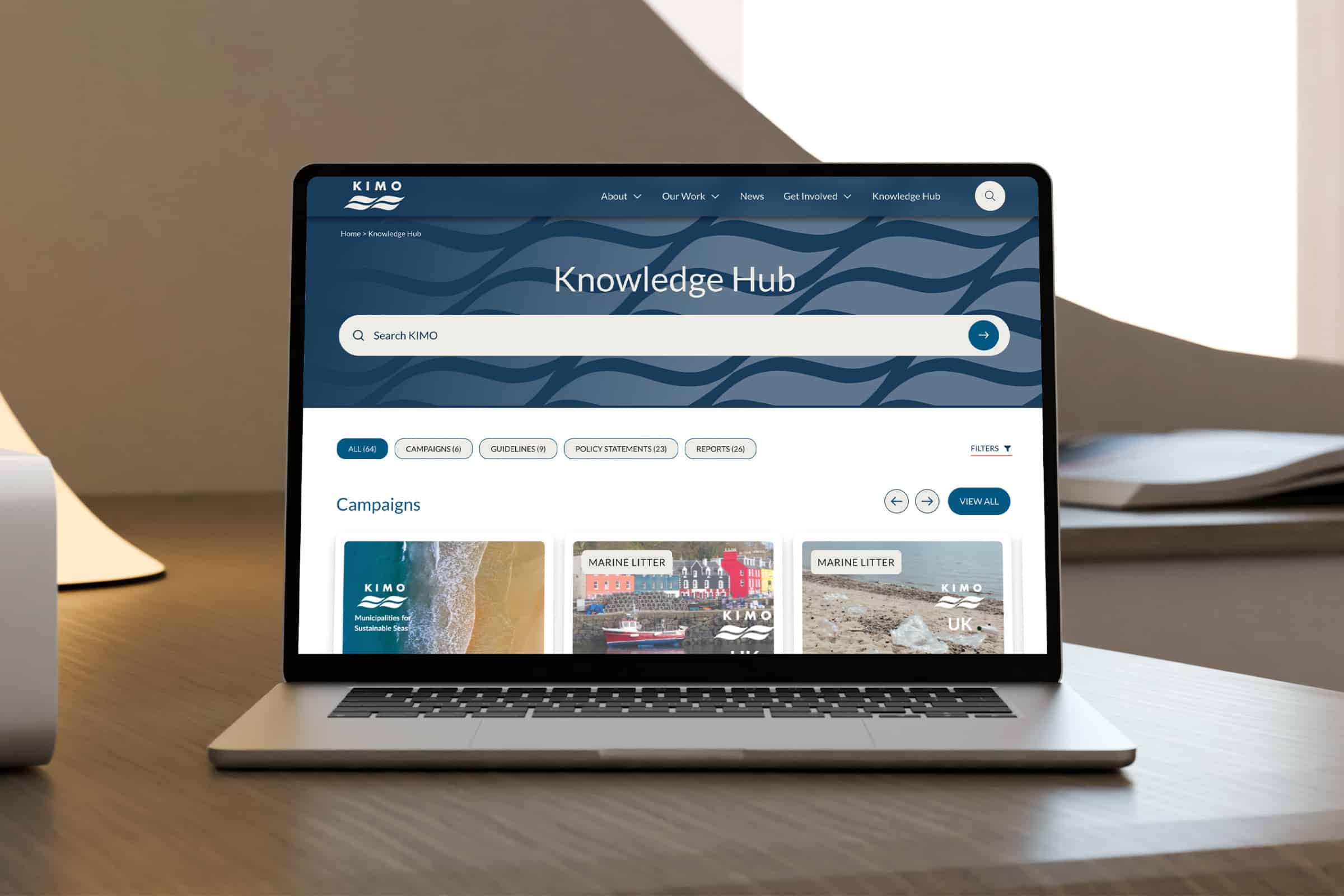
We created the Knowledge Hub as a single searchable directory for KIMO’s published work, grouping it into campaigns, guidelines, policy statements and reports, with filters for country, Action Area and year. Documents going back to the 1990s now sit alongside this year’s publications, and anyone can narrow them down in a few clicks.
The tagging system links everything to the three Action Areas. Projects and news stories carry the same tags as the archive, so each Action Area page becomes a route into all related work rather than a standalone description. A visitor reading about marine litter can move straight to the projects, reports and news behind it.
Page templates were built so the structure is scaleable. Chemical Pollution and Maritime Safety & Pollution use the same template as Marine Litter, and each national network page follows a shared model, so KIMO can add content without the site losing its shape.

